Content Creation
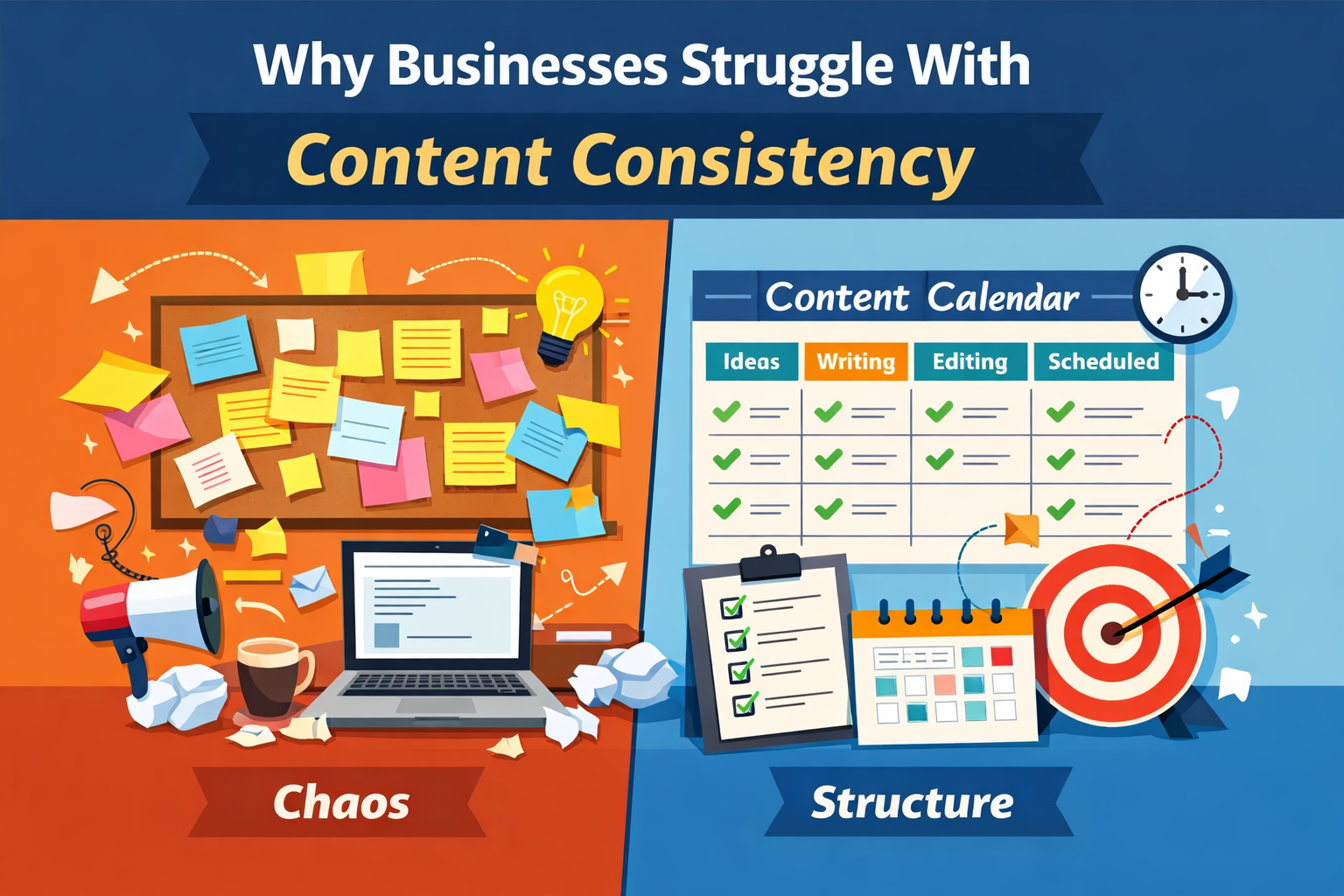
Why Businesses Struggle with Content Consistency — Even with Good Ideas
Many businesses today understand the importance of content.
They generate ideas, plan campaigns, and even invest in content creation tools.
Yet, despite good intentions and strong ideas, content efforts often become inconsistent.
Blogs stop midway.
Social media posting slows down.
Content strategies lose direction.
The problem is rarely a lack of ideas.
The real challenge lies in sustaining a structured content process.
The Real Problem Is Not Creativity — It’s Structure
Most organizations assume content consistency depends on creativity. In reality, consistency depends on systems.
Businesses typically face challenges such as:
- Lack of defined content processes
- Unclear ownership and responsibilities
- No structured content calendar
- Reactive rather than strategic planning
- Difficulty maintaining quality at scale
Without a clear framework, even the best ideas fail to translate into consistent output.
Common Reasons Businesses Struggle with Content Consistency
1. Lack of Clear Content Strategy
Many businesses create content without defining:
- Target audience
- Content goals
- Messaging direction
- Content themes
This leads to scattered efforts and irregular publishing patterns.
A structured strategy provides clarity and continuity.
2. Absence of Defined Content Processes
Consistency requires repeatable workflows.
However, most teams operate without defined processes for:
- Content planning
- Creation
- Review
- Publishing
- Performance tracking
Without process discipline, content becomes irregular.
3. Resource Constraints
Content creation demands time, expertise, and coordination.
Businesses often underestimate the effort required to sustain consistent output.
Teams already managing multiple priorities struggle to maintain momentum.
4. Over-Reliance on Ideas Instead of Systems
Idea-driven content works temporarily.
System-driven content works sustainably.
When content depends only on inspiration, production becomes unpredictable.
Structured workflows ensure continuity regardless of idea availability.
5. Quality vs. Quantity Conflicts
Businesses frequently struggle to balance:
- Speed of publishing
- Content quality
- Brand alignment
Without clear standards, content production slows down or stops entirely.
6. Impact of AI Without Strategic Direction
AI tools have made content creation faster, but not necessarily more consistent.
Organizations using AI without clear guidelines often face:
- Inconsistent messaging
- Lack of brand voice
- Content redundancy
- Poor strategic alignment
Technology accelerates production but cannot replace strategic clarity.
How Businesses Can Build Content Consistency
Develop a Structured Content Framework
Define goals, audience, content themes, and publishing frequency.
Create Repeatable Workflows
Establish clear processes for planning, creating, reviewing, and publishing content.
Maintain Editorial Guidelines
Document tone, style, and messaging standards to ensure consistency.
Use Content Calendars Effectively
Plan content in advance to avoid reactive publishing.
Focus on Long-Term Content Strategy
Consistency is a long-term discipline, not a short-term activity.
The Shift from Content Creation to Content Capability
Organizations are increasingly recognizing that content is not just a marketing activity but a business capability.
Consistency builds:
- Brand trust
- Audience engagement
- Market credibility
- Long-term visibility
Businesses that invest in structured content systems are more likely to sustain impact and achieve meaningful results.
Conclusion
Content inconsistency is rarely caused by a lack of ideas.
It is primarily a result of missing structure, unclear processes, and the absence of strategic direction.
As content continues to play a critical role in business growth, organizations must move beyond idea generation and focus on building sustainable content frameworks.
Consistency is not accidental — it is designed.